
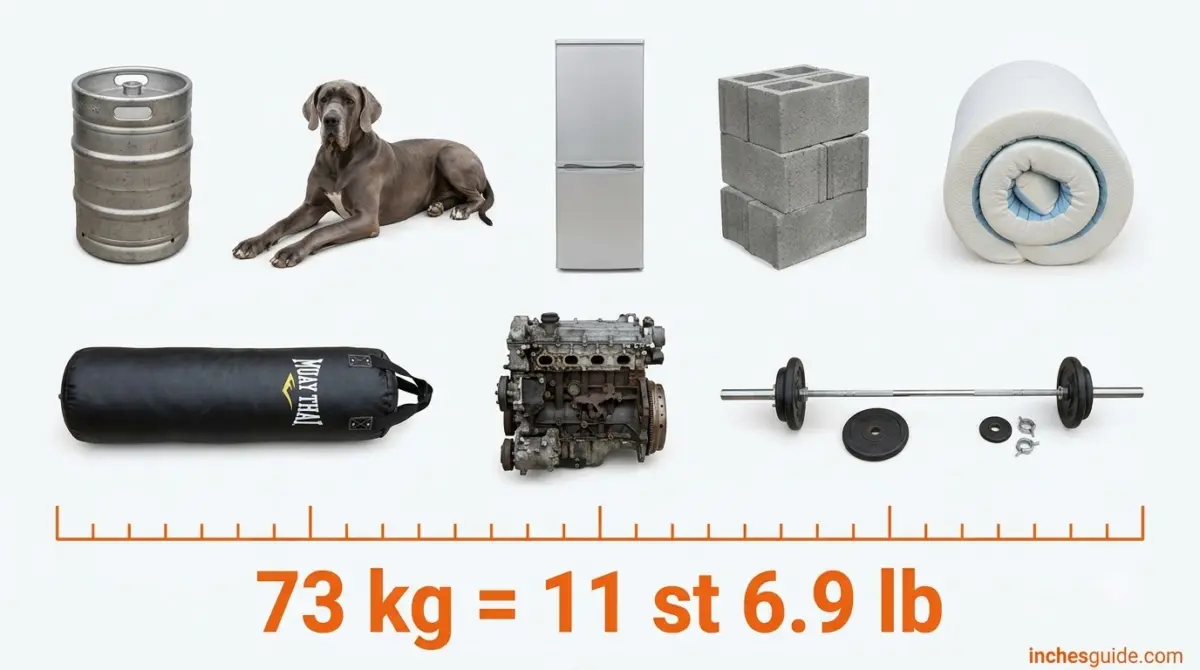
Ask a British person their weight and you’ll get stones and pounds. Ask their doctor and you’ll get kilos. Those two systems rarely meet in the middle.
That’s the whole reason this page exists. Most converters spit out 11.4955 stone and leave you there, which is useless if you actually want to say the number out loud.
Here’s the real answer, the chart, and eight things that weigh about the same.
73 kilos in stones and pounds is 11 stone 6.9 pounds, which most people round to 11 stone 7. In decimal, it’s 11.5 stone, or 160.94 pounds.
The Exact Conversion, Down to the Ounce
If you only need one line, it’s 11 st 6.9 lb. The rest is here for anyone who wants precision.
| Unit | 73 kg equals |
|---|---|
| Stones and pounds | 11 st 6.9 lb |
| Stones, pounds and ounces | 11 st 6 lb 15 oz |
| Stones (decimal) | 11.4955 st |
| Pounds (lb) | 160.94 lb |
| Pounds and ounces | 160 lb 15 oz |
| Ounces (oz) | 2,575 oz |
| Grams (g) | 73,000 g |
| Metric tonnes (t) | 0.073 t |
| US short tons | 0.0805 tons |
Rounded to the nearest pound, 73 kg in stones and pounds is 11 st 7 lb. That’s the version you’d actually tell someone.
Why the Answer Is Almost Never 11.5 Stone
This trips up more people than the maths does. Punch 73 into most tools, and you get 11.4955 stone, a number nobody has ever said in conversation.
The problem is that the decimal is not the pounds. That 0.4955 is a fraction of a stone, and a stone holds 14 pounds, so you multiply: 0.4955 × 14 = 6.9 pounds.
Get that wrong and you’d read 11.5 stone as 11 stone 5 pounds. You’d be almost two pounds off.
So the safe order is kilos, then pounds, then split the pounds into stones. Going straight from kilos to decimal stones is where people lose it.
Doing It in Your Head, No Calculator Needed
There’s a shortcut worth memorising. Divide the kilos by 6.35, and you get stones almost exactly, because one stone is 6.35029 kg.
73 ÷ 6.35 gives you 11.5 stone. Then take the 0.5, multiply by 14, and you land on 7 pounds.
The rougher method works too. Double the kilos, add ten percent, then split by 14. It gets you within a pound, which is close enough for most conversations.
And if you want it done for you, our kilograms to pounds calculator handles the first half of the sum instantly.
Why Your GP Says Kilos and You Say Stones
Britain never fully committed to metric, and weight is the clearest example. The NHS records patient weight in kilograms because every clinical formula runs on metric.
Drug doses are calculated per kilogram. So are anaesthetic amounts and fluid volumes. Nobody in a hospital wants to convert mid-procedure.
But outside the clinic, stones and pounds stuck. Scales sold in the UK usually show both, which is why so many people end up searching for 73 kg in stones and pounds after a check-up.
Ireland does the same dance. Australia, Canada and New Zealand dropped stones decades ago, so it’s really a British and Irish habit at this point.
Kilos to Stones and Pounds: 60 kg Through 100 kg
Bookmark this one. It covers the range most people need, including the neighbouring weights everyone checks next.
| Kilograms | Stones and pounds | Pounds |
|---|---|---|
| 60 kg | 9 st 6.3 lb | 132.28 lb |
| 61 kg | 9 st 8.5 lb | 134.48 lb |
| 62 kg | 9 st 10.7 lb | 136.69 lb |
| 63 kg | 9 st 12.9 lb | 138.89 lb |
| 64 kg | 10 st 1.1 lb | 141.10 lb |
| 65 kg | 10 st 3.3 lb | 143.30 lb |
| 66 kg | 10 st 5.5 lb | 145.51 lb |
| 67 kg | 10 st 7.7 lb | 147.71 lb |
| 68 kg | 10 st 9.9 lb | 149.91 lb |
| 69 kg | 10 st 12.1 lb | 152.12 lb |
| 70 kg | 11 st 0.3 lb | 154.32 lb |
| 71 kg | 11 st 2.5 lb | 156.53 lb |
| 72 kg | 11 st 4.7 lb | 158.73 lb |
| 73 kg | 11 st 6.9 lb | 160.94 lb |
| 74 kg | 11 st 9.1 lb | 163.14 lb |
| 75 kg | 11 st 11.3 lb | 165.35 lb |
| 76 kg | 11 st 13.6 lb | 167.55 lb |
| 77 kg | 12 st 1.8 lb | 169.76 lb |
| 78 kg | 12 st 4.0 lb | 171.96 lb |
| 79 kg | 12 st 6.2 lb | 174.17 lb |
| 80 kg | 12 st 8.4 lb | 176.37 lb |
| 82 kg | 12 st 12.8 lb | 180.78 lb |
| 84 kg | 13 st 3.2 lb | 185.19 lb |
| 86 kg | 13 st 7.6 lb | 189.60 lb |
| 88 kg | 13 st 12.0 lb | 194.01 lb |
| 90 kg | 14 st 2.4 lb | 198.42 lb |
| 92 kg | 14 st 6.8 lb | 202.83 lb |
| 94 kg | 14 st 11.2 lb | 207.23 lb |
| 96 kg | 15 st 1.6 lb | 211.64 lb |
| 98 kg | 15 st 6.1 lb | 216.05 lb |
| 100 kg | 15 st 10.5 lb | 220.46 lb |
Notice how the stone boundary lands at odd places. 70 kg is barely over 11 stone, and 89 kg is a whisker past 14. Those crossover points are why the conversion feels unpredictable.
8 Things That Sit Right on 73 Kilos
Numbers are easier to trust once you can picture them. Every item below lands within a pound or two of 160.94 lb.
A Full Half-Barrel Beer Keg
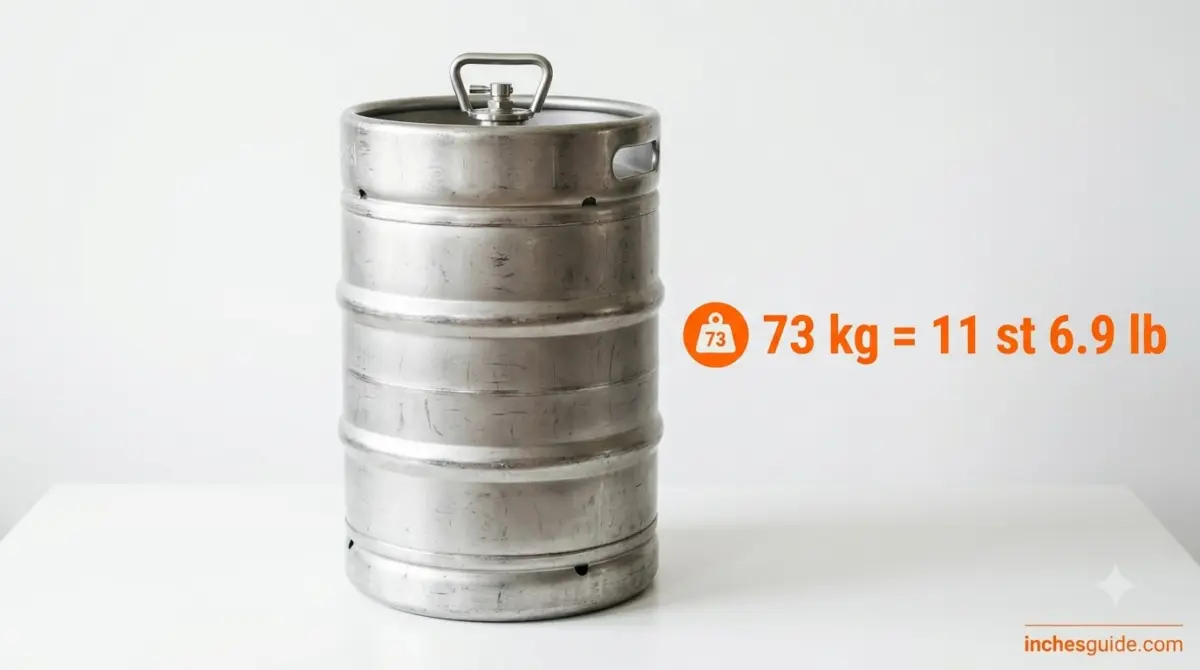
This is the closest match on the list. A full US half-barrel keg weighs about 160.5 pounds, which is 72.8 kg, so it’s practically sitting on our number.
The maths behind it is fixed. The empty stainless shell runs close to 30 pounds, and 15.5 gallons of beer adds roughly 130 more.
Bar staff will tell you this is exactly why kegs get rolled instead of lifted. Two people, a dolly, and no heroics.
The Olympic 73 kg Weight Class
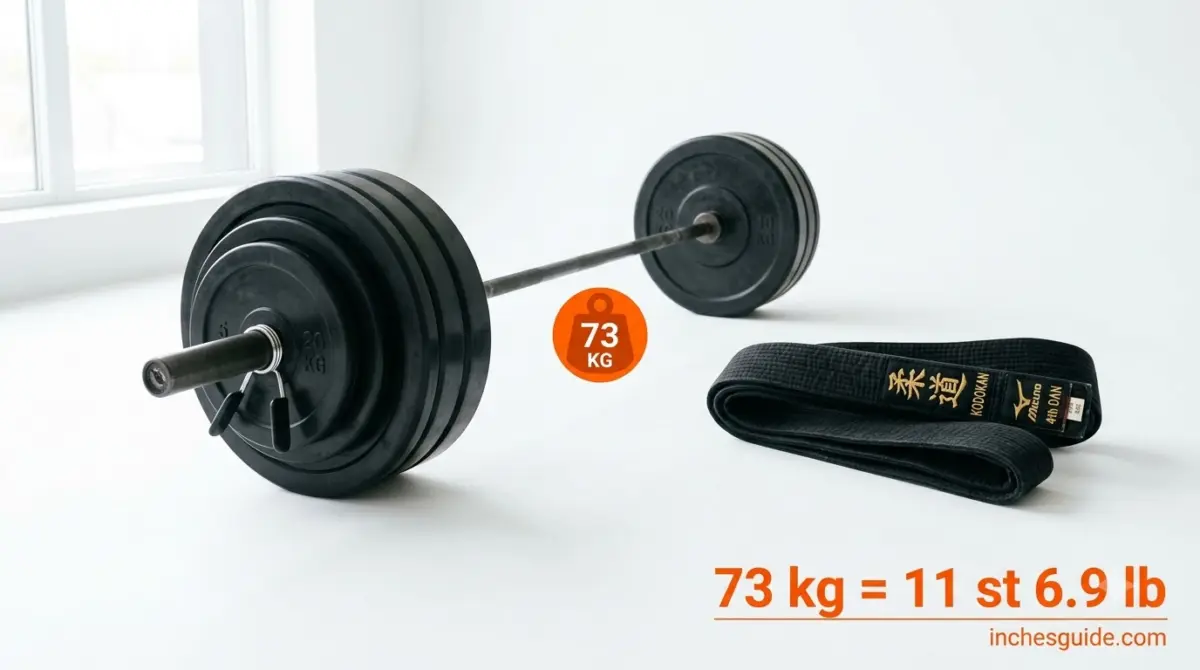
Here’s the one nobody expects. 73 kg isn’t a random weight, it’s an official Olympic division in two separate sports.
Men’s judo has a 73 kg category, and so does men’s weightlifting. Athletes in both spend fight week hovering at 11 st 6.9 lb, watching every gram.
The reason it exists is bracket spacing. Governing bodies split competitors into bands wide enough to be fair but narrow enough to stay competitive, and 73 landed as one of the dividing lines.
Weigh-ins are brutal about it. Come in at 73.1 kg and you’re out of the class entirely.
An Adult Male Great Dane
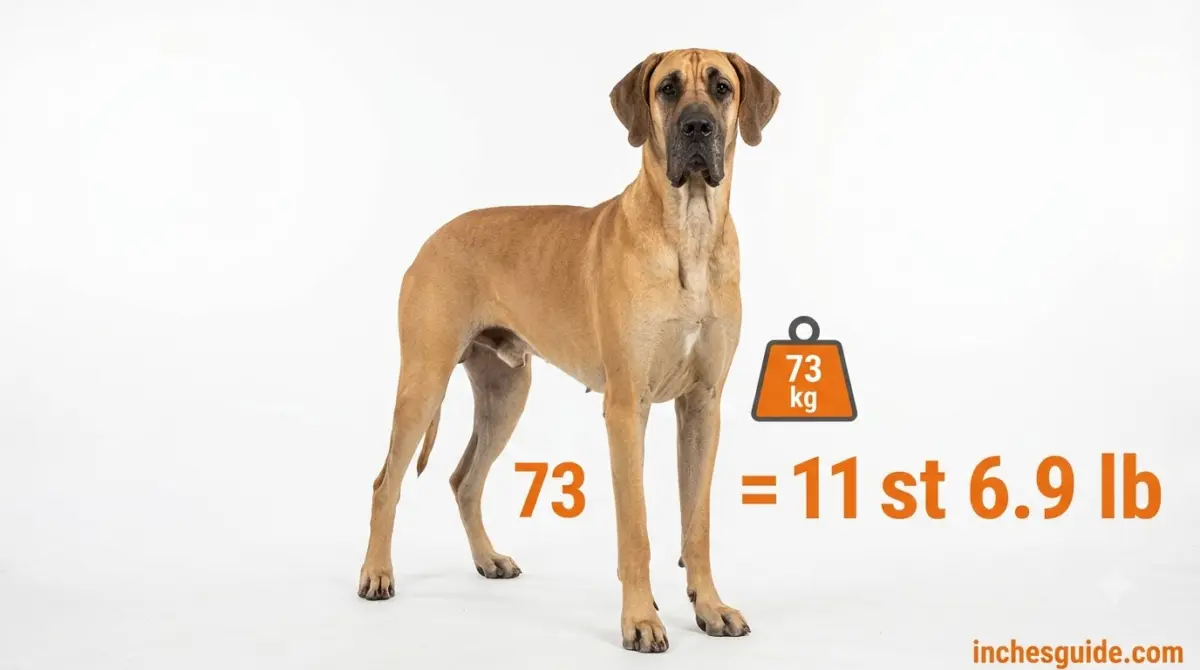
A full-grown male Great Dane typically runs 140 to 175 pounds, which puts the middle of that range right on 73 kg.
Their frame explains it. Dane bone density and chest depth were bred for boar hunting in Germany, and that structure carries serious mass even on a lean dog.
Anyone who has lifted one into a car boot knows the number instantly. It is a proper two-person job.
A Standard Fridge Freezer
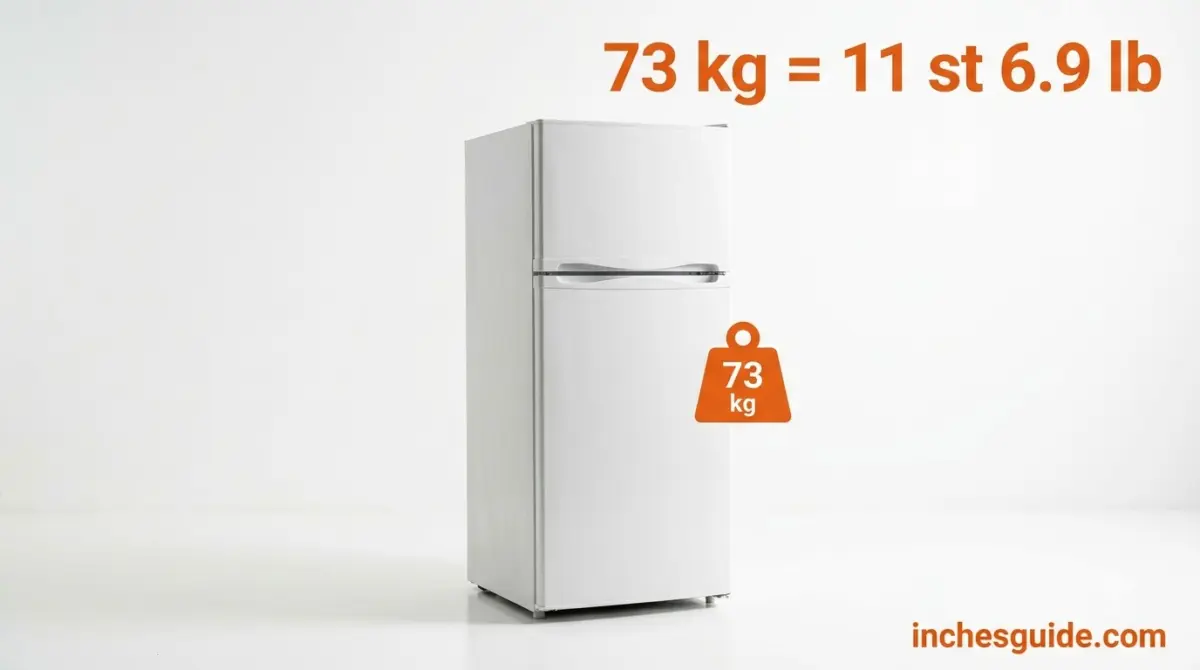
Look at the spec sheet for a mid-size fridge freezer, the 18 cubic foot sort, and the shipping weight usually lands between 68 and 77 kg.
Most of that is the compressor and the insulated cabinet, not the shelves. The foam layer inside the walls adds bulk you never see.
Delivery crews budget for this. It’s the reason a fridge takes two people and a stair trolley while a washing machine sometimes doesn’t.
Four Dense Concrete Blocks
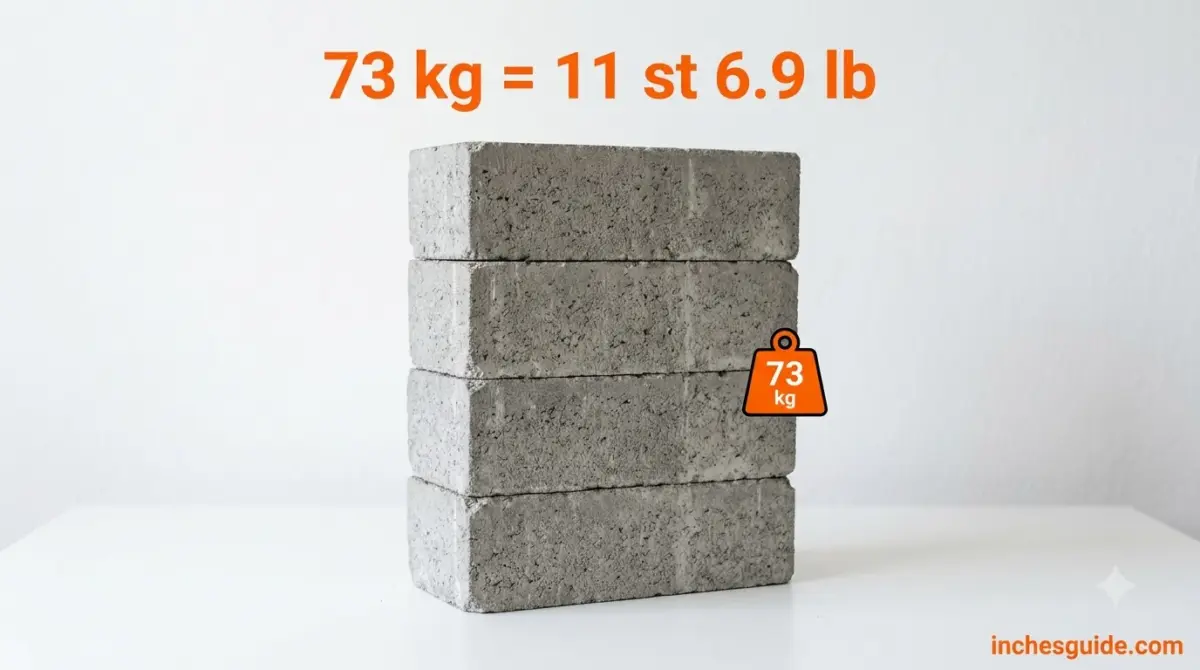
Builders think in blocks, and a standard UK dense concrete block weighs roughly 18 kg. Stack four and you’re at 72 kg.
The weight comes from aggregate density. Lightweight aerated blocks of the same size drop to around 8 kg, which is why bricklayers care so much about which pallet arrives.
Small aside: this is also the easiest way to feel 73 kg without a scale. Four blocks is a wheelbarrow load that nobody enjoys pushing.
A Queen Memory Foam Mattress
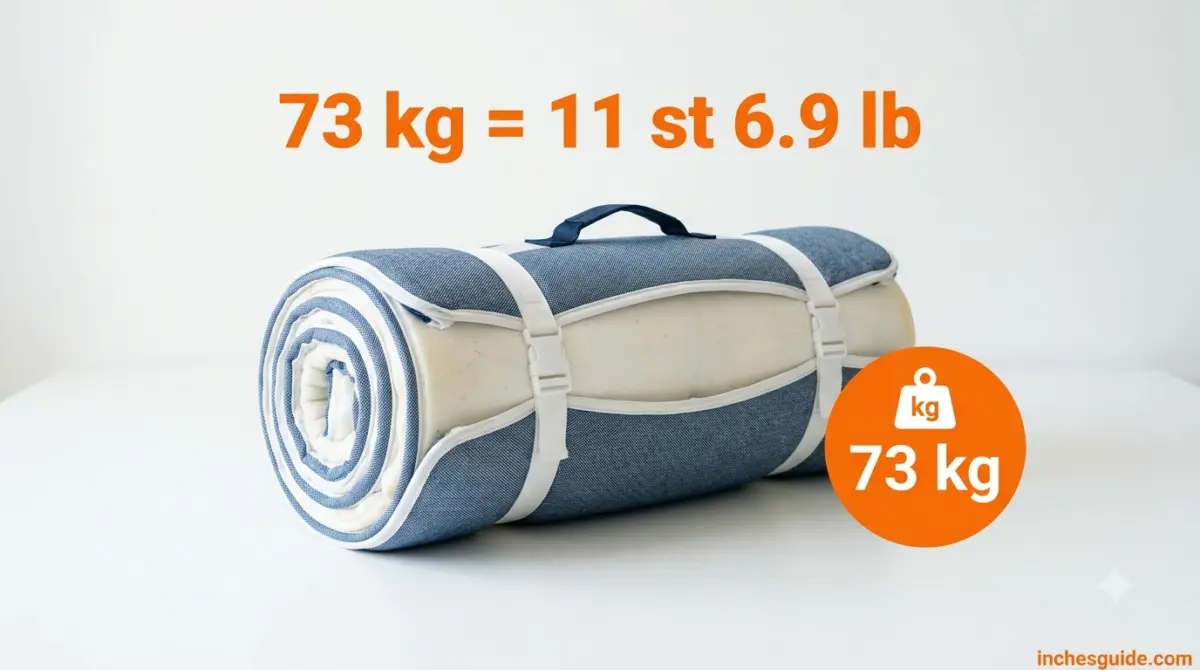
A 12 inch queen memory foam mattress commonly weighs 150 to 175 pounds, so 160.94 lb sits comfortably in the middle.
Density is doing the work here. High density viscoelastic foam packs far more material per cubic foot than an old spring mattress, which is why modern beds feel so much heavier than they look.
That’s also the reason boxed mattresses arrive compressed. Shipping 73 kg of loose foam would cost a fortune.
A Full Muay Thai Heavy Bag
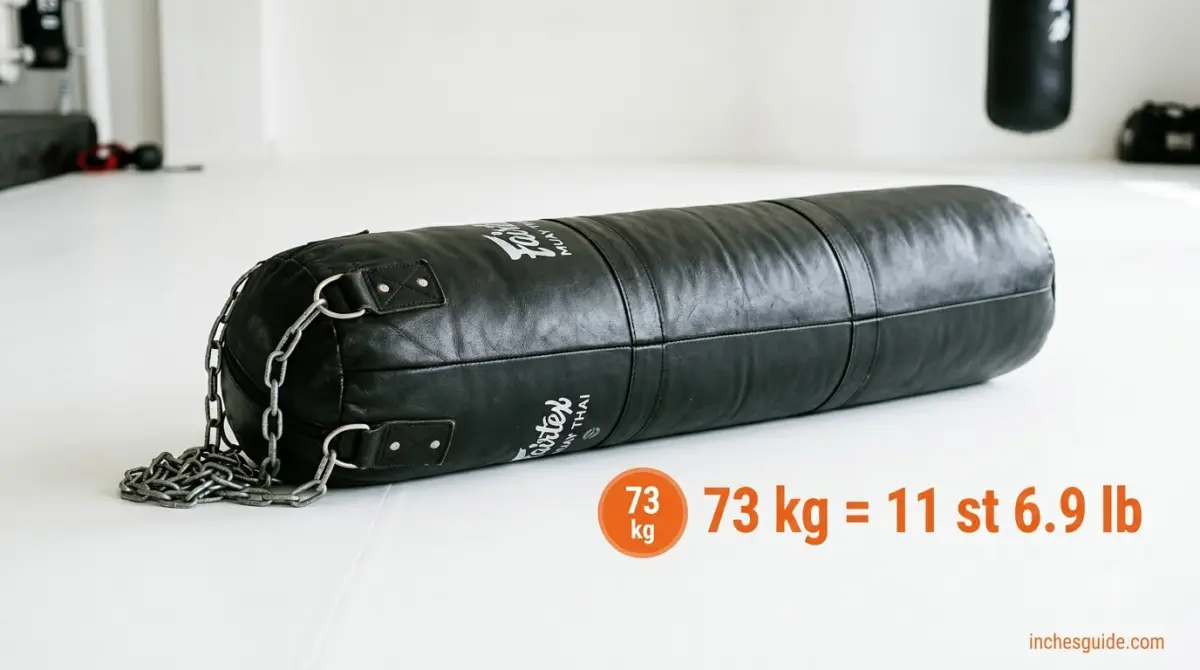
Banana bags, the long ones built for kicks, are sold filled at 150 and 160 pounds. The 160 lb version is 72.6 kg, near enough to be our twin.
Fillers matter more than you’d think. Shredded fabric packs denser than foam, so two bags of identical size can differ by 20 kg.
Gyms pick this weight on purpose. Lighter bags swing too much, and heavier ones punish the wrists.
A Bare Four Cylinder Engine Block
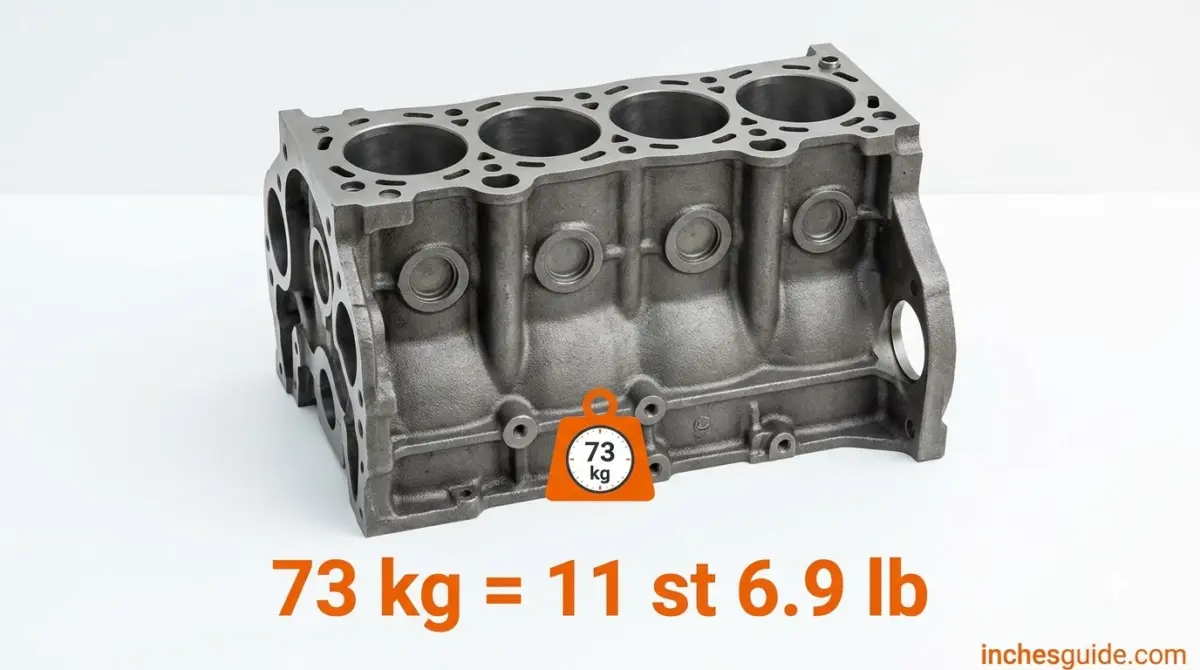
Strip a four-cylinder engine down to the bare cast iron block and you’re usually holding 150 to 165 pounds of metal.
Iron was the default for decades because it handles heat and pressure cheaply. Swap to an aluminium block and the same part drops to around 40 kg, which is why manufacturers made the switch.
Engine hoists exist for exactly this reason. A block this size is dead weight with nothing convenient to grab.
Questions
What is 73 kilos in stone?
73 kilos is 11.4955 stone, which reads as 11 stone 6.9 pounds. Round it, and you get 11 stone 7 pounds, the figure most people use day to day.
Is 73 kg the same as 11 stone 7?
Almost. 11 stone 7 pounds is 73.03 kg, so the difference is about 30 grams. For everyday purposes, they’re interchangeable.
How many pounds is 73 kg?
160.94 pounds, or 160 lb 15 oz to be exact. Multiplying kilos by 2.2 gets you to 160.6, close enough for a quick estimate.
Why does the NHS use kilograms instead of stones?
Clinical calculations like drug dosing are all worked out per kilogram. Using one metric unit throughout removes conversion errors, so patient records stay in kilos.
What is 72 kilos in stones and pounds?
72 kg is 11 stone 4.7 pounds. Each kilogram moves you about 2.2 pounds, so every step up or down shifts the pounds column noticeably.
One Number Worth Memorising
Keep 6.35 in your head and you’ll never need a converter again. Kilos divided by 6.35 gives stones, and the decimal times 14 gives the pounds. For 73, that’s 11 stone 7. Say it once and it sticks.