
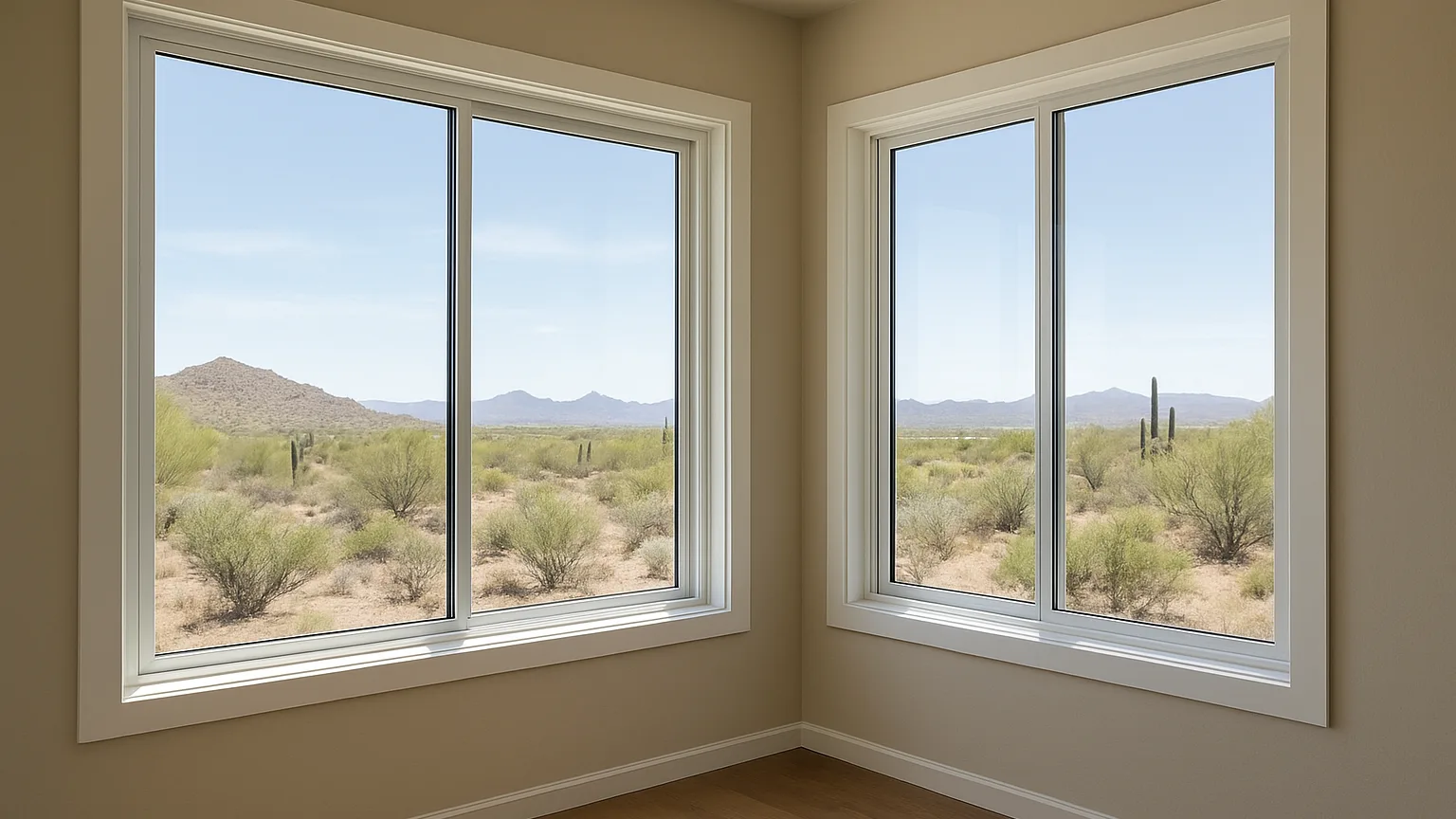
Most window advice you’ll read was written for a leafy suburb with mild summers and a creek down the street. Albuquerque isn’t that. If you’ve walked barefoot across a west-facing living room floor at 4 p.m. in July, you already know the difference. The same window that performs fine in Seattle can cook your carpet here, and the gap that lets in a pleasant breeze in Portland lets in a gram of fine sand every time the wind picks up.
So the real question isn’t “should I replace my windows.” It’s which window actually survives this valley, and what separates one from the next. If you’re weighing window replacement in Albuquerque, the honest answer is that two thirds of the outcome has nothing to do with the glass and everything to do with fit, coating, and the way the frame handles a 40-degree daily temperature swing.
Here’s what I mean by that, and how to tell whether a quote in front of you is a good one.
What your windows are actually fighting
Albuquerque sits at roughly a mile above sea level, which means thinner air, brutal ultraviolet exposure, and a sun that hits harder than the elevation bump alone would suggest. Add the spring winds that push topsoil across the mesa and you get three enemies at once: heat gain, UV decay, and grit.
Old single-pane glass loses the fight on all three. The pane itself acts like a hot plate in summer and a cold sheet in winter, and the frame around it, usually aluminum or old wood, expands and contracts with the day-night swing until the seals give out. Once a seal fails, you don’t just lose efficiency. You get condensation between the panes, and that fog is permanent.
Vinyl handles this climate better than aluminum for one boring reason: it moves less. Less movement means the weatherstripping stays seated, and the frame keeps its shape through hundreds of hot afternoons.
The parts that actually decide how long a window lasts
Glass coating and the gas inside
Low-emissivity coatings, usually just called Low-E, are thin metallic layers that reflect heat back where it came from. In a cooling-dominated climate, you want a coating tuned to reject solar heat before it enters the room. Argon gas between the panes adds an insulating layer that plain air doesn’t provide.
According to the Department of Energy, windows can account for a meaningful share of a home’s heating and cooling load, which is the entire reason coatings and gas fills exist. None of this is exotic. It’s standard on decent vinyl units now, so if a quote doesn’t mention it or gets vague when you ask, that tells you something.
The frame and how it’s fastened to your house
This is where Albuquerque homes get interesting. Plenty of houses here have stucco exteriors, and stucco doesn’t forgive a sloppy install. You can’t just caulk over a gap and hope. The window has to sit plumb, flash correctly, and seal against a surface that was never perfectly flat to begin with. The National Institute of Standards and Technology exists partly to keep measurement and building standards consistent, and that matters more than most homeowners realize when an installer is deciding whether a quarter inch of variance is acceptable. It usually isn’t.
My take: on a stucco house, installation quality outranks window brand every single time. I’d rather have a mid-tier vinyl unit set perfectly than a premium unit jammed in and caulked.
Original framework: the Three-Season Test
I use this when I’m looking at a house, and you can run it on any quote you’re handed. Score each window on three seasons, because that’s how the desert actually tests them.
- Summer: Does the glass package specify solar heat rejection, not just “energy efficient”?
- Wind: Does the unit have a multi-point lock and full-perimeter weatherstripping, or a single latch and a hopeful strip of foam?
- Winter: Will the frame stay tight through freeze-thaw cycles without cracking at the corners?
Any window that passes all three is a keeper. A window that only passes summer is a window that’ll be whistling at you by February.
Five decisions you’ll make before the truck shows up
Most of the stress in a window project happens before installation day, in the choices below. Get these right and the rest is logistics.
- Which windows first. Don’t replace the whole house if budget is tight. Start with west and south facing units, which take the worst of the afternoon sun, then work outward.
- Style. Sliding and double-hung units are the workhorses. Sliding windows in particular suit wide openings and are easy to operate with one hand, which matters more as you get older.
- Install method. Full-frame replacement means pulling the old frame; pocket replacement fits a new unit into the existing frame. Pocket is faster and cheaper, full-frame gives you a cleaner seal when the old frame is already compromised.
- Color and hardware. Vinyl can be ordered in several tones. Pick something that matches your trim rather than your mood on the day of the appointment.
- Warranty language. Read for what’s covered specifically: seal failure, vinyl distortion, and hardware. A lifetime warranty that only covers glass defects is barely a warranty at all.
One more thing worth checking before you sign: whether the contractor will pull permits. Some cities require them for window replacement, and skipping that step can bite you at resale. The Department of Housing and Urban Development publishes homebuyer and homeowner resources that explain why documented improvements matter when a house changes hands.
What this costs you if you get it wrong
Here’s the texture nobody puts in a brochure. I’ve stood in a Northeast Heights living room in August where the homeowner had replaced four west-facing windows two summers earlier with the cheapest units a big-box store sold. The glass was fine. The frames had separated at two corners, and you could feel hot air pushing through a gap you couldn’t see. She’d spent money to solve a problem and bought the problem again in a new color.
Compare that to a Corrales house I walked through last spring with vinyl units installed six years prior. Same desert, same wind. Windows still tight, still clear, no fogging, and the homeowner’s only complaint was that she’d waited so long to do it.
The difference wasn’t luck. It was a spec sheet that named the coating, a frame rated for the temperature swing, and an installer who treated stucco like stucco instead of drywall.
Quick gut check before you sign anything
Ask for the glass package in writing. Confirm the warranty covers seal failure and frame distortion, not just breakage. Get the install method in the contract, pocket or full-frame. Ask who pulls the permit. And ask what happens if a unit arrives the wrong size, because in custom manufacturing, that happens, and the answer tells you how the company operates when something goes sideways.
If a salesperson can’t answer those five questions on the spot, that’s your answer.
Albuquerque rewards homeowners who plan for the sun and the wind instead of pretending they’re minor details. Your windows sit on the front line of both, every single day, for decades. Pick the ones that were built for this exact fight, get them set properly, and you’ll stop thinking about them entirely. That’s the goal, honestly. The best window in your house is the one you never notice.
So before your next quote lands in your inbox, go stand by your hottest window at 4 p.m. and put your hand near the frame. Feel anything? Now you know where to start.