
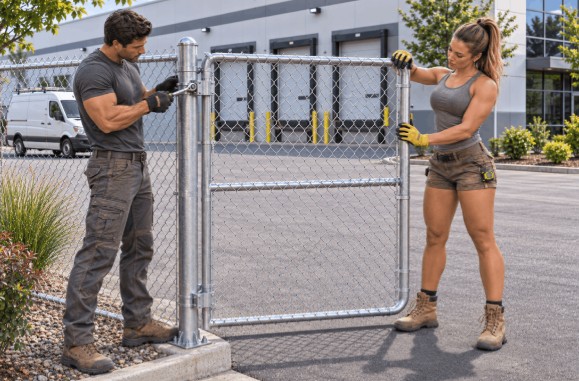
Nobody wants to spend a few thousand dollars on a new fence and then get a letter from the City asking them to take it down. It’s even worse to find out a year later that your fence is sitting 30 centimetres onto your neighbour’s lot.
The good news is that Surrey’s fence rules are fairly short once you know where to look. Most of them live in one section of the City’s Zoning Bylaw. Chain link also gets a special break that other fence types don’t, which surprises many homeowners.
This guide covers what you need to know before the first post goes in: height limits, corner lots, property lines, permits, pools and the few materials that aren’t allowed. It’s a plain-language summary, not legal advice. For anything unusual about your lot, a quick call to the City’s zoning line at 604-591-4086 is worth the five minutes.
Fence Height Limits in Surrey
Surrey’s fence rules are in Part 4 (General Provisions) of the Surrey Zoning Bylaw No. 12000. For residential lots, three numbers cover most situations.
In your backyard and along your interior side yards, a fence can be up to 1.8 metres high (about 6 feet). That’s the standard limit across most residential lots.
In the required front yard and in the street-side yard on a corner lot, the limit drops to 1.2 metres, or about 4 feet.
Corner lots also have a sight triangle, which runs 9 metres along each lot line from the street corner. Inside that triangle, a fence can be no taller than 1.0 metre, or about 3 feet 3 inches.
A few details are worth understanding.
“Required front yard” means the setback, not the whole front lawn. The 1.2 m limit applies inside the minimum front setback your zone requires. If your house sits farther back than that minimum, part of the space in front of it may not count as the required front yard. Your zone’s setback tells you exactly where that line falls.
Corner lots have a sight triangle. Picture the corner where two streets meet. Measure 9 metres along each property line from that corner and join the two points with a straight line. Anything inside that triangle is capped at 1.0 m so drivers can see around the corner.
Retaining walls count toward the height. If a fence sits on top of a retaining wall, the bylaw measures the wall and fence together. If the combined height goes over 1.8 m, the fence itself can be no taller than 1.0 m. This catches a lot of people on sloped lots in South Surrey and around Panorama Ridge.
The chain link exception most people don’t know about
This is where chain link gets a real advantage. The bylaw says its fence restrictions don’t apply to hedges, shrubs, and trees, and they also don’t apply to an open mesh or chain-link fence that doesn’t restrict vision.
In plain terms, standard see-through chain link isn’t bound by the height limits in the table above. That’s why you’ll see taller chain link around sports courts, school fields and some larger residential properties.
There’s a catch, though. The exception only covers chain link you can see through. Weave in privacy slats, hang a windscreen or attach a fabric screen, and the fence now restricts vision. At that point, the normal height limits apply again. If you’re planning slats, plan the height as if it were a solid fence.
A few other things can still limit a chain link fence even when the zoning exception applies:
- Restrictive covenants on title. Some newer subdivisions, especially lots next to parks, greenways or streams, have covenants that cap fence height or require a particular style.
- Strata bylaws. If you’re in a townhouse complex or bare-land strata, the strata’s rules can be stricter than the City’s.
- Development permit guidelines. In some areas, design guidelines tied to a development permit can affect what’s allowed.
- Common sense at corners. Even a see-through fence can block sightlines if it’s covered in vines or overgrown.
If you’re thinking about anything unusual, like a tall chain-link fence across the front of your property, confirm it with the City’s zoning line before you order materials.
Materials and Special Cases
Barbed wire, razor wire and electric fencing
On residential lots, barbed wire and electric fencing aren’t allowed. The bylaw makes exceptions for agricultural zones and for acreage lots of 2 hectares or more, where you might need to keep livestock in.
Razor wire and barbed tape are banned in every zone in Surrey, including commercial and industrial land. If you’re fencing a business yard in Campbell Heights or Port Kells and want something on top of the chain link, talk to your contractor and the City about what’s allowed for your zone before you order it.
Pool fencing
Pools have their own bylaw. Surrey’s Private Swimming Pool Fencing Regulation Bylaw No. 4450 applies to private pools larger than 150 square feet and deeper than 18 inches. The main requirements:
- The fence must be at least 4 feet high and enclose the pool or the yard around it.
- No openings can be larger than 4 inches. Standard 2-inch chain-link mesh easily meets this.
- Every gate must be self-closing and return to a locked position on its own.
- The spring lock must sit at least 3 feet 6 inches above the ground and open only from the pool side.
- Gates must stay locked whenever there’s water in the pool.
Chain link is one of the most practical ways to meet these rules, since it’s see-through, strong and affordable. The gate hardware is where the details matter, so make sure your installer knows the fence is for a pool.
Property Lines: Get This Right Before You Dig
The City’s position is simple: a fence has to be on your property. Fences also can’t go on City property or on any City right-of-way or easement. That sounds obvious, but old fences are a terrible guide to where your line actually is. Many were built by a previous owner, on a guess, decades ago.
How to find your property line
- Look for survey pins. These are metal markers, usually buried a few centimetres below the surface at the corners of your lot. A metal detector helps.
- Check the City’s records. Surrey may already have a survey certificate for your lot on file, and you can request a copy.
- Search your title. A title search through the Land Title and Survey Authority (LTSA) will show any easements, rights-of-way or covenants that could affect where a fence can go.
- Hire a BC land surveyor if there’s any doubt. A surveyor can find and mark your lines. It costs money, but far less than tearing out and rebuilding a fence in the wrong spot.
Building on the line vs. just inside it
You have two options. If you and your neighbour agree to share the fence, it can go on the shared line, and you’ll usually split the cost. Get that agreement in writing. The City is clear that it has no jurisdiction over disputes about shared fences, so if things go sour later, you’re on your own.
The other option is to keep the fence entirely on your side. Many installers set the posts a few inches inside the line so the concrete footings, which spread out underground, don’t cross onto the neighbour’s lot. You own and control the fence, and you don’t need anyone’s sign-off.
Either way, talk to your neighbour before the crew shows up. A five-minute conversation over the fence you’re replacing heads off most disputes before they start.
Call BC 1 Call before anyone digs.
Every fence post is a hole in the ground, and there may be gas, power or cable lines down there. BC 1 Call does free utility locates, and you’ll typically get the information back within a few days. Your contractor should request one, but if they don’t, you can request it yourself.
Do You Need a Permit for a Fence in Surrey?
For an ordinary residential fence, no. The City states plainly that a building permit isn’t required to build a fence. You still have to follow the zoning rules on height and location, but there’s no application to fill out or fee to pay.
A few related projects are different:
- Retaining walls. Surrey requires a retaining wall permit for walls over 1.2 m in certain situations, such as walls that support ground critical to a building’s foundation or walls on sloping hillsides. These need a registered professional’s sign-off. If your fence project involves building or rebuilding a wall, sort out the wall first.
- Automated gates. A powered driveway gate that needs new wiring falls under electrical permits, which are separate from building permits.
- Pools. The pool itself needs a permit. The fence around it must meet the pool fencing bylaw described above.
What if you need something the bylaw doesn’t allow?
If following the rules would cause real hardship because of your lot’s shape or slope, you can apply to Surrey’s Board of Variance for a minor variance. The City has approved taller front-yard fences through variances before. Expect paperwork and some waiting, so apply well before you plan to build.
Your Pre-Install Checklist
Before you sign a contract or book a crew, run through this list:
- Find your property line (survey pins, City records or a land surveyor)
- Check your title for covenants, easements or rights-of-way.
- Check strata bylaws, if you’re in a strata.
- Confirm the height limit for each section of the fence: back, side, front and corner.
- If you want privacy slats, plan the height as if it were a solid fence.
- Check for retaining walls and measure the combined height.
- Talk to your neighbours, and put any cost-sharing agreement in writing.
- Make sure a BC 1 Call locate is requested before digging.
- For pools, confirm the gate hardware meets the pool fencing bylaw.
The Bottom Line
For most Surrey homeowners, the rules come down to this. Keep solid fences to 1.8 m in the back, 1.2 m in the front setback and 1.0 m at street corners. Stay on your own side of the property line. Skip the barbed wire. And remember that plain, see-through chain link gets a pass on the height limits until you add slats.
No building permit is needed for a standard fence, but that doesn’t mean no homework. An hour spent checking your survey, your title and your neighbour’s plans can save you from rebuilding a fence you only just paid for.
If you’d rather have someone who already knows the local rules handle it, Poker Link Fence is a Surrey-based fence contractor that installs residential and commercial chain-link fence in Surrey and across the Lower Mainland. They can walk your property, flag any height or property line issues before work starts, and give you a detailed written quote.