
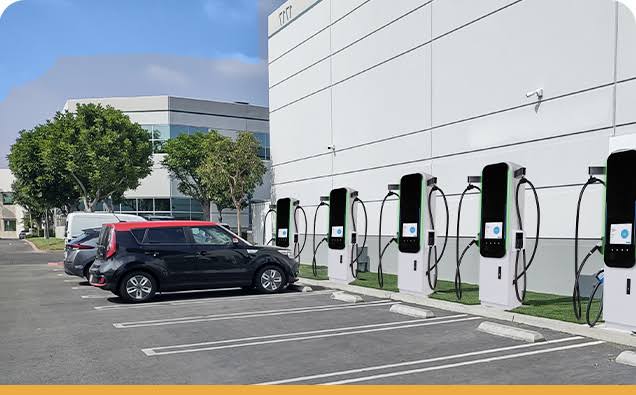
Electric vehicles are no longer a niche choice. Employees are showing up to work in EVs, visitors are asking where they can plug in, and companies that want to look modern and attract talent are paying attention. The question for most employers is no longer whether to offer charging, but how to do it without creating a new headache for facilities teams. That is where a managed approach to workplace EV charging comes in.
Why Workplace Charging Matters
Workplace EV charging lets employees and visitors charge their vehicles while parked at work. For drivers, it turns an eight-hour workday into a built-in refuel, removing the need to rely entirely on home charging or detours to public stations. For employers, it is a practical perk that signals commitment to sustainability and employee wellbeing.
There is a competitive angle too. As more people switch to electric, charging access is becoming something job candidates notice. Offering it can help a company stand out, support retention, and encourage further EV adoption among staff. For landlords of multi-tenant office buildings, charging works as a shared amenity that adds value to the property and helps attract and keep tenants.
The Four Obstacles Most Employers Face
Despite the benefits, many organizations hesitate. The concerns are usually the same.
Limited electrical capacity. Many buildings simply do not have spare power for large-scale charging. Traditional installations can trigger expensive service upgrades, which stalls projects before they begin.
Reliability and uptime. A broken charger is worse than no charger. When workplace stations malfunction, employees plan their day around a service that fails them, and frustration builds quickly.
Growing demand. Today’s handful of EV drivers can become a queue within a couple of years. A system sized only for current need forces a costly redesign later.
Operational burden. Facilities and operations teams are already stretched. Adding chargers, billing, user support, and maintenance to their plate is rarely welcome.
A good workplace charging solution has to address all four at once.
How a Managed Workplace Charging Project Works
Ampaway’s workplace EV charging solutions are built around handling the work end to end, so the employer does not have to coordinate multiple vendors. The process follows three stages.
- Site evaluation. It starts with an assessment of the building, its electrical capacity, and the parking layout. This shapes the right setup for the property and ensures the system can grow later.
- Installation and activation. The provider manages permits, installation, and system setup from start to finish. Chargers are installed, connected to the software, and activated without disrupting daily operations. Installation is performed by EVITP-certified installers, with fully permitted electrical and construction work.
- Ongoing operation and scaling. After launch, the provider operates and maintains the system. Employers can monitor usage through a simple dashboard, adjust access policies, and add chargers as demand rises.
The result is that charging becomes an amenity that runs in the background rather than another project to manage.
Solving the Power Problem With Load Management
The most common technical barrier is electrical capacity, and the most effective answer is dynamic load balancing. Instead of assuming every charger needs full power at all times, the system distributes the available electricity across all connected chargers. More vehicles can charge at the same time, and the building does not need heavy infrastructure upgrades.
This matters for budgets and timelines. Many workplaces can install chargers using the power they already have, rather than waiting on utility work or major electrical investment. Every project still begins with a site assessment, so the design is built around the real capacity of the building rather than guesswork.
Costs, Rebates, and Predictability
Cost uncertainty is another reason projects stall. Ampaway emphasizes predictable operating costs through a clear pricing structure, so employers can plan without worrying about hidden fees or surprise maintenance bills.
Upfront spending can also be reduced. In many cases, no upfront costs are required, since flexible models can reduce or eliminate initial investment. Rebates may be available for workplace charging as well, and in some cases they can cover up to 100% of project costs, depending on the property and eligibility. The provider handles permitting and rebate paperwork, which removes another layer of administrative effort. As always, eligibility varies, so it is worth confirming the details for your specific site.
Control, Access, and Software
Employers often ask who gets to use the chargers. With the right software, the answer is entirely up to you. Access can be set for employees, visitors, or specific groups, and managed through one dashboard. The same interface lets you track performance, review usage, and enable billing.
This flexibility works well in shared parking areas, where chargers can serve multiple employees throughout the day. You decide who can use them and how they are used. Behind the scenes, a unified platform connects chargers, payments, and monitoring, and the Ampaway mobile app is available on iOS and Android for drivers.
Reliability You Do Not Have to Manage
Uptime is where many charging programs succeed or fail. Under a managed model, the provider monitors the system, maintains the hardware, and provides in-house support. If something stops working, their team responds, so your facilities staff does not have to. Installation and operation also follow local electrical and building regulations, keeping the workplace compliant.
Where Workplace Charging Fits
Ampaway’s workplace EV charging solutions suit a range of environments:
- Corporate offices with employee parking, where charging is a practical advantage for staff who drive EVs.
- Business parks and campuses, where large parking areas allow charging to be installed in phases as adoption grows.
- Commercial buildings with tenant parking, where shared charging adds property value and supports tenant retention.
- Offices offering charging as an employee benefit, which helps make the company more attractive and competitive.
Choosing the Right Chargers
Different workplaces need different hardware. Two options stand out for this setting. The AMP CORE is a Level 2 charger designed for flexibility, smart load balancing, and seamless app integration, making it a strong fit for parking where vehicles stay for hours. The AMP FLEX is a Level 3 charger that pairs flexible installation with high performance and advanced control and monitoring tools, suited to business parking and fleets that need faster turnaround.
For most office settings, Level 2 charging is enough, since cars sit parked through the workday. Faster Level 3 units make sense where vehicles turn over quickly or where visitors and fleet use are significant.
What to Look for in a Provider
When comparing workplace EV charging solutions, a few questions can guide the decision:
- Will the provider handle permitting, installation, and rebates, or will you coordinate it yourself?
- Can the system work within your existing electrical capacity?
- Who maintains the chargers and responds to faults?
- Can the system scale as more employees go electric?
- Is pricing clear and predictable?
A partner that answers yes to these questions lets you focus on your core business while employees get a reliable charging experience.
Conclusion
Workplace EV charging has moved from a nice-to-have to a meaningful part of how organizations support their people and their properties. The barriers that once held employers back, including limited power, unreliable hardware, scaling concerns, and the burden on internal teams, can now be addressed through load management and a fully managed service model.
By starting with a thorough site evaluation, using intelligent power distribution, and relying on a provider that installs, operates, and maintains the system, employers can offer charging with minimal involvement from their own staff. For companies ready to meet growing EV demand, a managed solution like Ampaway’s workplace EV charging solutions offers a straightforward path from first assessment to a charging program that grows with the workforce.