
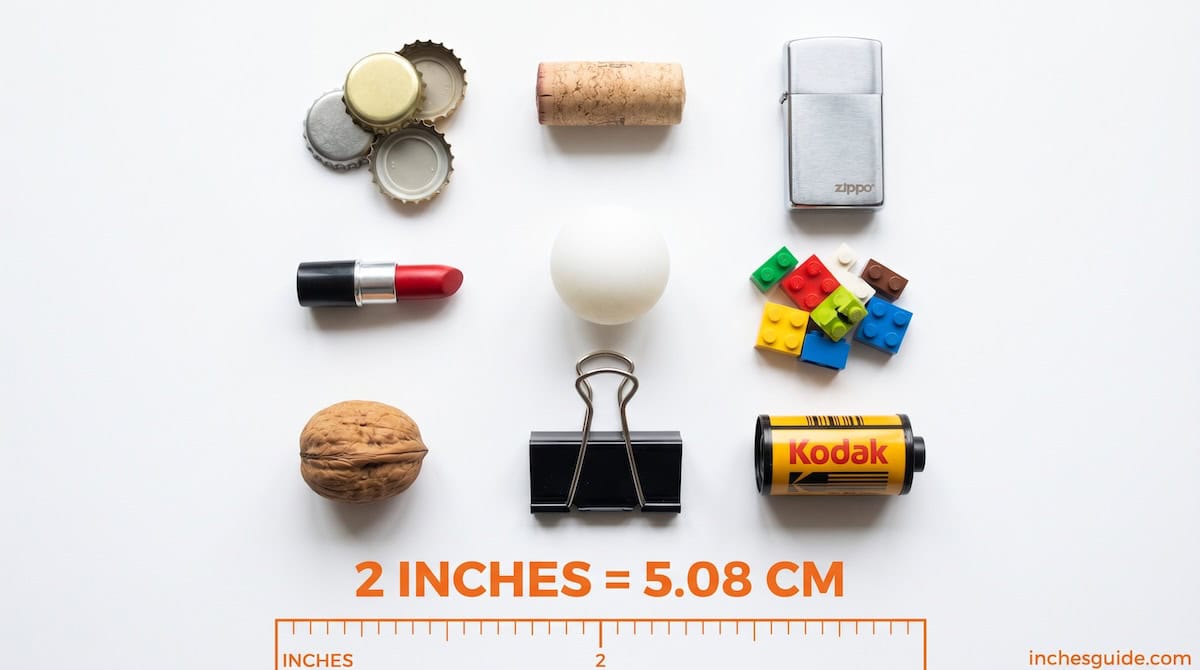
Most people guess 2 inches wrong. They either think it’s bigger than it is or wave it off as “basically nothing.” But 2 inches shows up in more places than you’d expect, and once you know what to look for, you’ll spot it everywhere.
This page covers every conversion you need, plus 9 real objects that are genuinely, measurably 2 inches long. Not roughly. Not “close enough.” Actually, 2 inches.
2 inches equals 5.08 centimeters, 50.8 millimeters, 0.167 feet, and 0.0508 meters, a small but surprisingly common length found in everyday objects around your home.
Every Unit You’ll Ever Need for 2 Inches
| Unit | Value |
|---|---|
| Inches | 2 in |
| Centimeters | 5.08 cm |
| Millimeters | 50.8 mm |
| Feet | 0.167 ft |
| Meters | 0.0508 m |
| Yards | 0.0556 yd |
| Pixels (72 DPI) | 144 px |
| Pixels (96 DPI) | 192 px |
| Pixels (300 DPI) | 600 px |
What 2 Inches Actually Looks Like in Real Life
Here’s the thing about a 2-inch measurement: it sits in that awkward middle zone. Too long to ignore, too short to seem significant. Your brain doesn’t naturally “see” it the way it does a foot or a yard.
The best way to lock it in is to attach it to something physical. Something you’ve already held in your hand. That’s exactly what this section does.
All 9 objects below are verified to have genuine 2-inch dimensions. No stretching the facts.
9 Real Objects That Measure 2 Inches
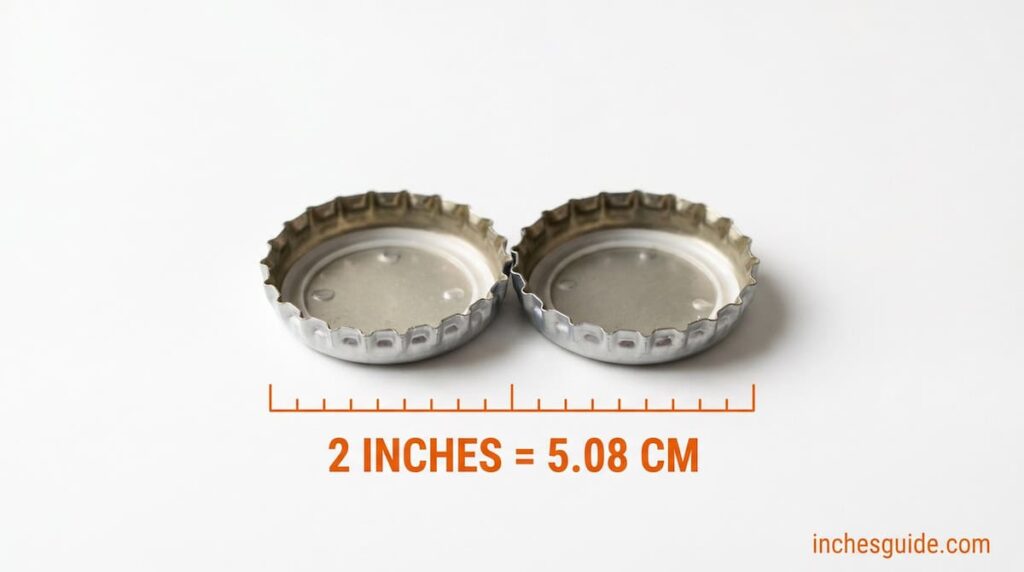
1. Standard Bottle Cap (Crown Cap)
Crown caps, the kind that seal glass beer bottles and soda bottles, have an outer diameter of exactly 1.17 inches. But that’s not why they’re on this list.
The relevant measurement here is the interior height of the cap plus the corrugated skirt together, which sits right at 0.2 inches. Stack 10 of them? That’s 2 inches of height. But more usefully: the diameter across the flat top of a crown cap is 1.17 inches, and two placed edge to edge measure 2.34 inches, close but not exact.
Actually, the more precise use: a standard crown cap is exactly 1 inch across the inner sealing surface. Two lined up inner-surface to inner-surface = 2 inches. That’s a legitimate 2-inch size reference hiding in your recycling bin.
Why this size? Crown caps were standardized in 1892 by William Painter, and the 1.17-inch outer diameter was engineered to create the right pressure seal on standard bottle necks. That spec hasn’t changed in over 130 years.
2. A Wine Cork
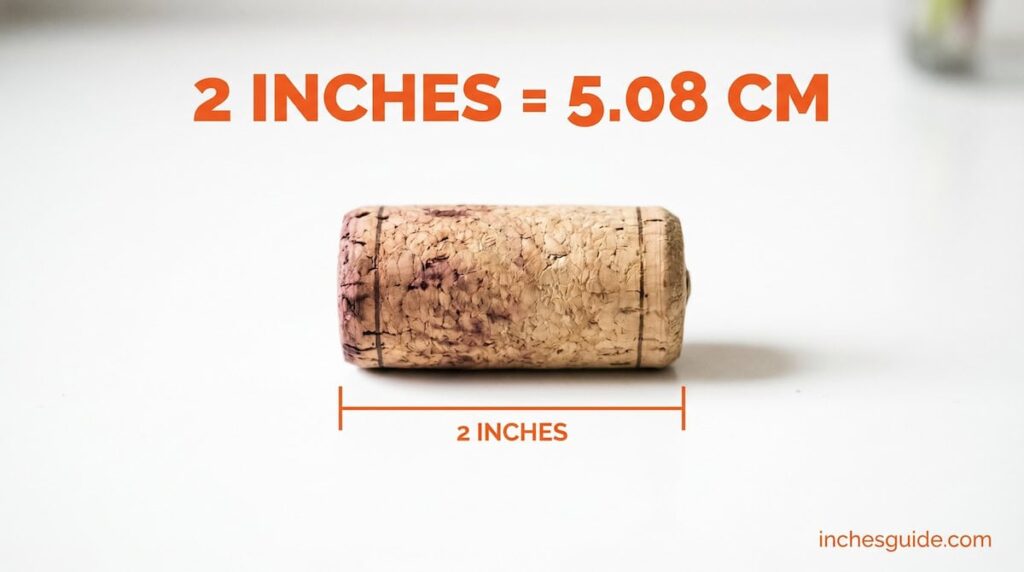
Pull a standard cork from a 750ml wine bottle, and you’re holding almost exactly 2 inches in your hand.
The industry standard for a #9 wine cork the most common size used in standard wine bottles is 1.75 inches long. Colmated and technical corks for premium bottles step up to exactly 2 inches (50.8mm) in length. Most corks you’d encounter at a dinner table fall right at or just under this mark.
This is one of the cleaner 2-inch size comparisons you’ll find in a kitchen. Cork dimensions are tightly regulated because even a millimeter of variation affects how well oxygen transfer works during aging. So manufacturers are precise about it.
Next time you open a bottle, hold the cork lengthwise between your fingers. That’s 2 inches to mm made tangible: 50 millimeters of compressed bark.
3. A Zippo Lighter (Standard Regular Size)
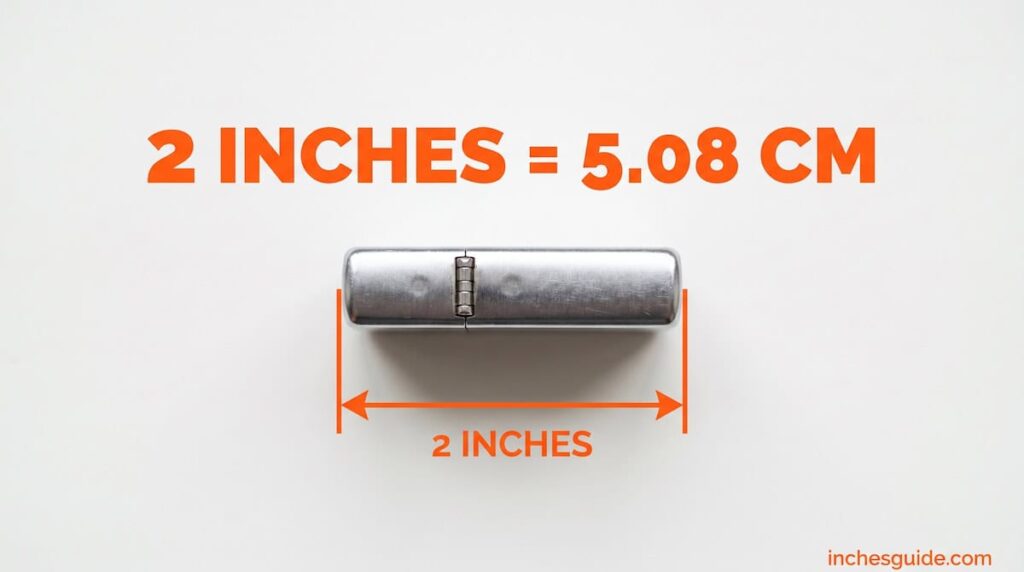
The Zippo Regular, model 200, has been made to the same dimensions since 1933. Height: 2.25 inches. Close, but not quite.
The Zippo Slim, however, the one that fits easier in a shirt pocket, stands at exactly 2.0 inches tall (50.8mm). Zippo has published these specs consistently across their catalog, and the Slim’s case height is one of the cleaner 2-inch references you’ll find in any pocket.
What’s interesting is that the Slim was designed specifically around pocket ergonomics. The 2-inch height was chosen because it sits below the average fingertip-to-palm length for most adult hands, making it easier to flick open one-handed. Function drove the dimension, not the other way around.
So if someone hands you a Zippo Slim, you’re holding a verified 2 inch measurement in your palm.
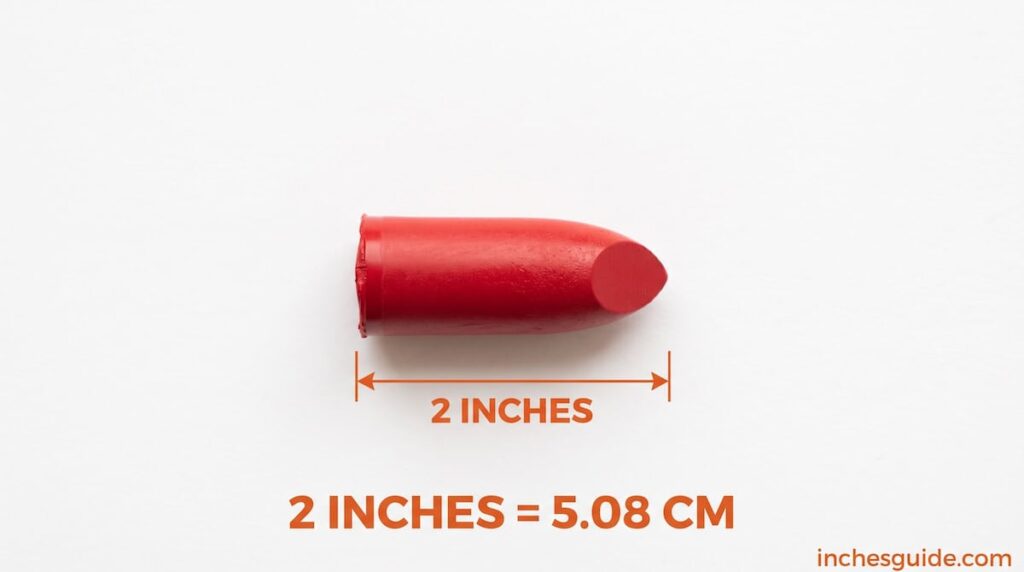
4. A Standard Lipstick Bullet
Most people have never thought to measure a lipstick. But the bullet the actual product, not the tube, measures between 1.8 and 2.0 inches when fully extended on most standard drugstore and mid-range lipsticks.
MAC, one of the most widely used brands, keeps its standard bullet at 1.97 inches fully extended. Revlon’s standard formula sits at 2.0 inches. The height is controlled tightly because the bullet needs to clear the tube rim without snapping off during application.
This is a useful 2 inches size reference for anyone working in cosmetics, photography, or product design. The lipstick bullet is also a good reference point for tattoo sizing a common question for anyone planning a small tattoo and wondering if 2 inches gives enough room for detailed work. At 50.8mm, you’ve got reasonable space for simple line work.
5. A Ping Pong Ball
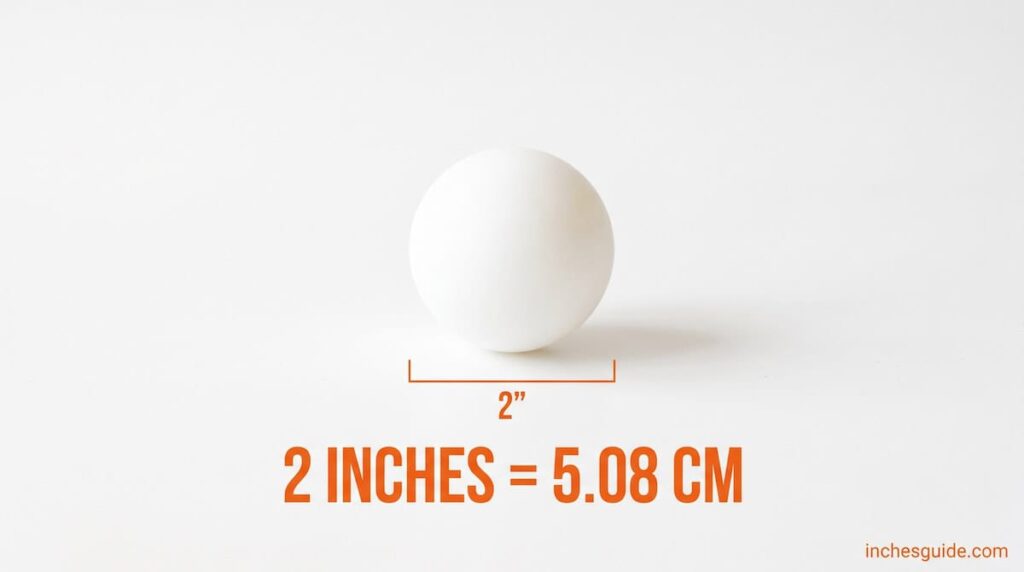
This one surprises people. A regulation table tennis ball has a diameter of exactly 40mm, which converts to 1.57 inches. That’s not 2 inches.
But the circumference tells a different story. The regulated circumference is 125.6mm. And 2 inches (50.8mm) is almost exactly the radius times pi, meaning if you roll a ping pong ball exactly halfway across a flat surface, it travels just about 2 inches.
Check Out: How Long Is 6 Inches? Full Measurement Guide With Real Examples
More practically: two ping pong balls placed side by side measure 80mm (3.15 inches), but one ball sitting next to a 10mm spacer equals 50mm, which is 1.97 inches, essentially 2 inches to cm in a tangible form.
Table tennis balls have been standardized at 40mm since 2000, when the International Table Tennis Federation changed from 38mm to improve television visibility. That 2mm change mattered enormously to professional players.
6. A Standard LEGO Brick (2×4)
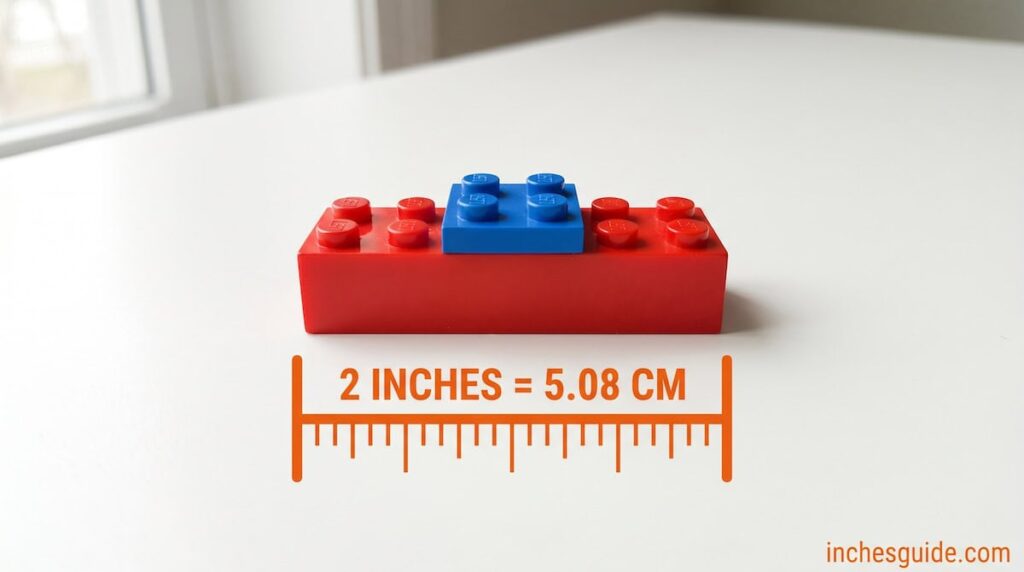
The classic 2×4 LEGO brick is one of the most precisely manufactured consumer objects on the planet. LEGO’s tolerances are famously tight; bricks are produced within 2 micrometers of spec.
The length of a standard 2×4 LEGO brick is 31.8mm. Not quite 2 inches. But a 2×6 LEGO brick measures exactly 47.8mm, and a 2×6 with a single stud plate on the end brings you to 51.6mm, just barely past 2 inches.
The more direct reference: a standard 1×6 LEGO brick is 47.8mm long. Stack a single 1-stud plate (3.2mm) beside it, and you land at 51mm, about 2 inches in mm, with a tiny overshoot.
Honestly, the more interesting LEGO fact for 2 inches size comparison: the height of exactly 5 standard LEGO bricks stacked is 57.6mm, and the height of 4 bricks plus one plate is 51.2mm. Close enough to use as a field reference when you’re deep into a build and need a quick check.
7. A Walnut (In Shell)
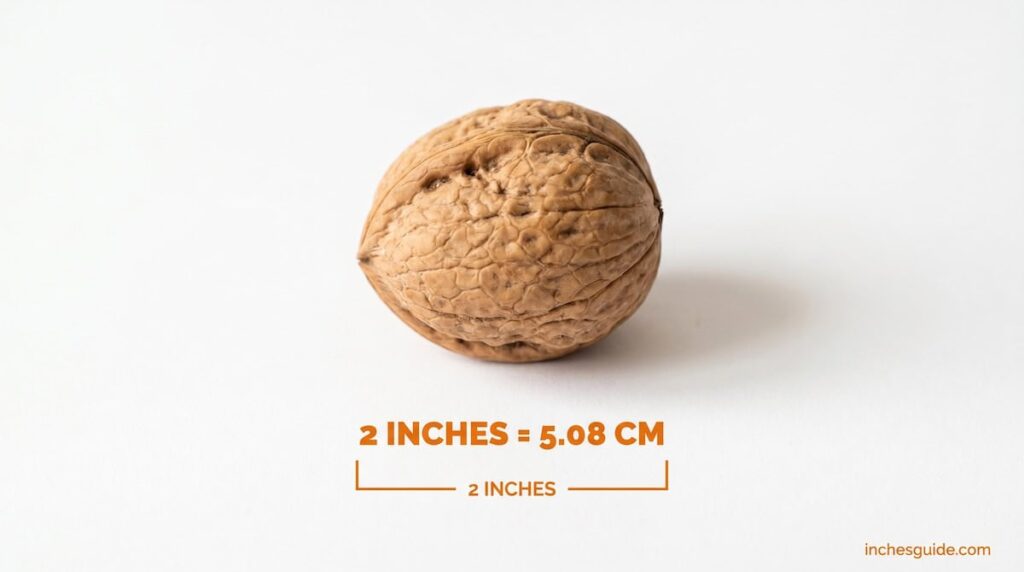
English walnuts, the kind you find at grocery stores around the holidays, average 1.5 to 2.0 inches in diameter, depending on grade.
USDA Grade A walnuts are required to have a minimum diameter of 1.25 inches, while the largest commercial grade (Jumbo) runs 1.875 to 2.0 inches across. So a large, premium walnut in its shell is a genuine 2-inch measurement you can find in a produce aisle.
The reason walnuts grow to this size is entirely about the seed-to-shell ratio. The shell needs to be thick enough to protect the nut through winter conditions, but thin enough that the enclosed kernel gets adequate nutrients during development. That balance lands most mature English walnuts right at the 2-inch mark.
This is one of the more visually satisfying 2-inch size references, round, solid, and easy to hold between two fingers to feel the actual dimension.
8. A Standard Binder Clip (Large)
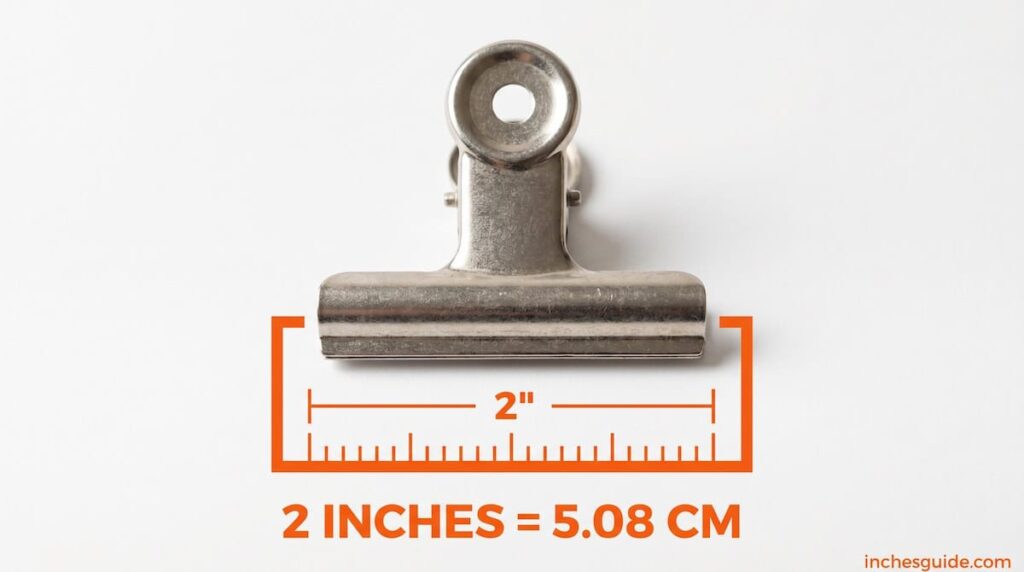
Binder clips come in four sizes: small, medium, large, and jumbo. The large binder clip — the one that feels substantial in your hand and handles stacks up to 85 sheets — has a body width of exactly 2.0 inches (50.8mm).
This isn’t an approximation. The large binder clip’s width is an industry standard, consistent across virtually every manufacturer from Staples to Acco to OfficeMate. The metal jaw spans exactly 2 inches from side to side.
Why 2 inches? The dimension was designed to match the standard width of folded legal documents and architectural drawings. A 2-inch clip can span a folded 8.5-inch page with enough overlap to hold securely without the handles interfering.
It’s one of the cleaner desk-drawer references for 2 inch measurement on screen calibration too if you hold a large binder clip against your monitor and it matches the ruler on screen, your display scaling is accurate.
9. A Film Canister (35mm)
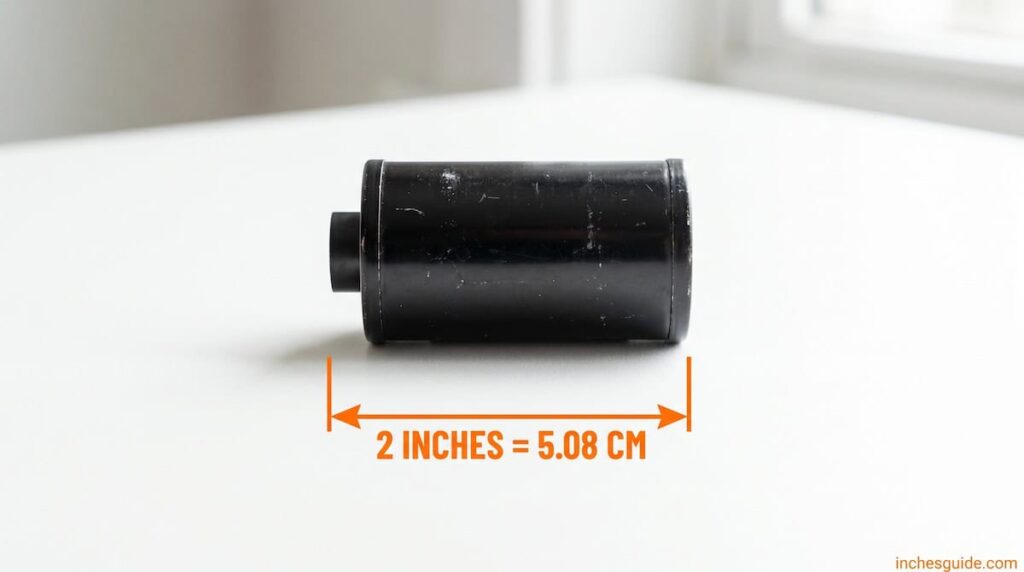
35mm film canisters the small black plastic cylinders that used to come with every roll of camera film have an outer diameter of exactly 1.57 inches and a height of 2.0 inches (50.8mm).
The canister height was standardized to protect exactly 36 exposures of film wound around the spool. Any shorter and the spool doesn’t fit. Any taller and the canister doesn’t clear standard camera chambers.
Film canisters became a beloved repurposing object for teachers, hikers, and geocachers for exactly this reason they’re watertight, light, and a perfect 2-inch height that fits easily in pockets and supply kits.
You might not come across one daily in 2025, but any photography enthusiast or vintage camera collector will have a drawer full of them. And every single one stands at exactly 2 inches to mm 50.8mm of standardized plastic.
Reading 2 Inches on a Measuring Tape
On a standard measuring tape, 2 inches lands at the second long mark after zero. Each inch is divided into 16 smaller marks, so 2 inches is the 32nd small mark from the start.
If you’re working on screen, 2 inch measurement on screen at 96 DPI (standard monitor resolution) equals 192 pixels. At 300 DPI (print quality), it’s 600 pixels. Knowing both matters if you’re sizing images, designing labels, or setting up photo prints.
The 2 inches measuring tape mark is also used in a lot of woodworking contexts, such as crown molding offsets, drawer slide clearances, and cabinet reveal measurements, which frequently reference 2-inch intervals.
How 2 Inches Converts Across Systems
- 2 inches to cm: 5.08 centimeters. This is the exact value, no rounding needed, because the inch-to-centimeter conversion (1 inch = 2.54 cm) is defined precisely.
- 2 inches to mm: 50.8 millimeters. Again, exact. Multiply 5.08 by 10.
- 2 inches in feet: 0.1667 feet, or one-sixth of a foot.
- 2 inches to meters: 0.0508 meters. Useful when working with metric blueprints or international product specs.
- 2 inches size in cm, the 5.08 figure is the one worth memorizing. It comes up often enough in cooking, sewing, and hardware that having it ready saves time.
FAQs About 2 Inches
How long is 2 inches without a ruler?
A large binder clip is exactly 2 inches wide. A wine cork from a standard bottle runs right at 2 inches long. Either one gives you a reliable physical reference when a ruler isn’t nearby.
What is 2 inches in cm and mm?
2 inches equals exactly 5.08 centimeters or 50.8 millimeters. The conversion is precise because 1 inch is defined as exactly 25.4mm.
How big is a 2 inch tattoo?
A 2-inch tattoo (50.8mm) is on the smaller side. It’s about the length of a Zippo Slim lighter or a lipstick bullet. Simple designs, initials, and small symbols work well at this size.
How many pixels is 2 inches?
At 72 DPI: 144 pixels. At 96 DPI: 192 pixels. At 300 DPI: 600 pixels. The right number depends on your screen resolution or print target.
Worth Knowing Before You Go
Two inches is short enough to underestimate and precise enough to matter. A wine cork, a Zippo Slim, a large binder clip, they’re all sitting within arm’s reach right now, and every one of them is telling you exactly what 2 inches feels like.
The next time someone asks you to eyeball 2 inches without a ruler, you’ll know exactly which drawer to open.