
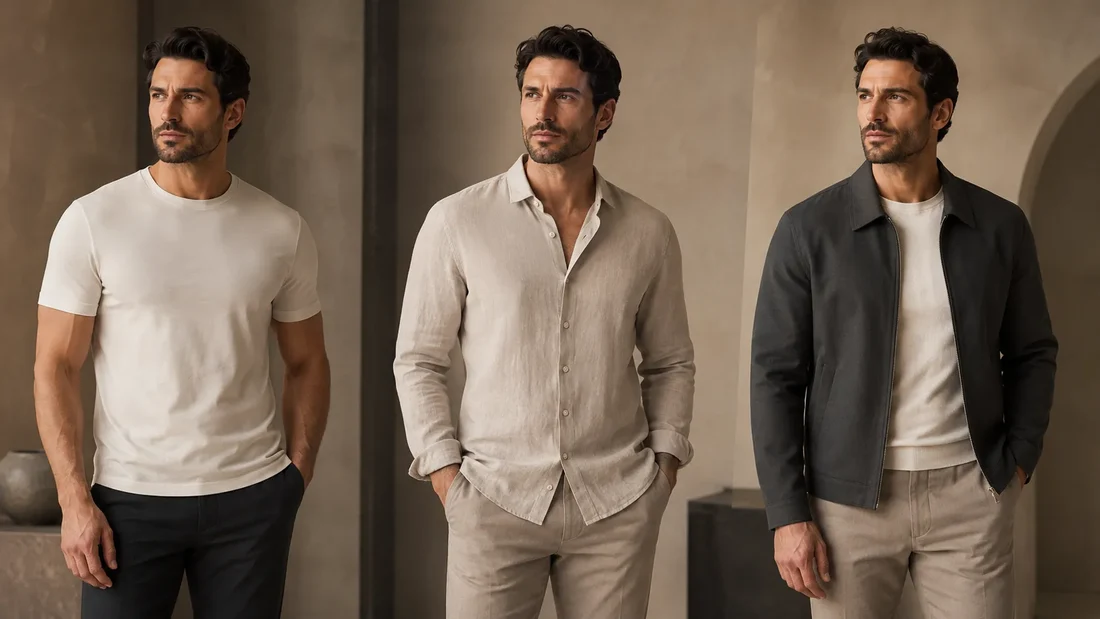
Men with an athletic build often face the same frustration. A shirt that fits across the chest and shoulders hangs loose around the middle, gathering in folds when tucked in. Size down and the buttons strain. The answer lies in understanding shirt fits rather than simply chasing sizes.
Why Off-the-Rack Shirts Struggle
Most ready-made shirts are cut for an average chest-to-waist ratio. When your shoulders are wider and your waist slimmer than that average, the fabric has nowhere to go but outwards. The result is the billowing effect that makes a tucked shirt puff over the belt like a parachute.
The good news is that manufacturers now offer several cuts designed for different body shapes.
Classic, Tailored and Slim Explained
Classic fit is the roomiest. It allows generous space through the chest and waist, making it comfortable for larger frames but often too loose for athletic builds.
Tailored or modern fit sits in the middle. It narrows through the waist while keeping comfortable movement in the shoulders and chest. This is frequently the best starting point for broad-shouldered men.
Slim fit tapers more sharply. It suits lean frames well, but men with very developed chests or arms may find it tight across the upper body.
Look for These Details
A few features help shirts follow an athletic shape. Back darts, which are vertical seams stitched into the rear panel, pull excess fabric in at the waist. Side seams cut on a curve rather than straight also reduce bulk.
Check the armholes too. Higher, closer armholes allow more arm movement without lifting the whole shirt when you reach forward.
The Fabric Factor
Some fabrics drape better on athletic builds. Cotton with a small percentage of elastane gives a little stretch, which helps across the chest and shoulders. It also recovers its shape after long hours of sitting at a desk. Softer weaves fall closer to the body, while stiff, heavy cotton tends to stand away from it.
When trying on white shirts, pay particular attention to this, because pale fabric shows every fold and gather more clearly than darker shades.
Testing Fit Properly
Button the shirt fully and stand naturally. Look for pulling across the chest, where the fabric forms an X shape around the buttons. Raise your arms above your head; the shirt should stay mostly tucked. Turn sideways in a mirror and check for excess fabric around the lower back.
If you find a shirt that fits your shoulders but remains loose at the waist, a tailor can usually take it in at modest cost and effort.
Under a Jacket
A well-fitted shirt also improves how your jacket sits. Excess fabric bunches beneath the lining and creates bulges at the waist and back. A closer shirt lets the jacket drape cleanly from the shoulders down.
A Shape-Friendly Wardrobe
Broad shoulders and a trim waist are an advantage once your clothes cooperate. Choose tailored cuts, look for darts and curved seams, consider a little stretch and test movement before buying. Your shirts will finally follow your frame instead of fighting it.