
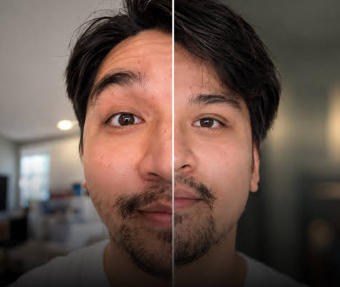
You catch your reflection in a shop window and barely recognise it. A friend’s photo from across the table looks nothing like the selfie you took that morning. Then the bathroom mirror shows yet another version. It’s common, and there are sound reasons for it.
The mirror shows a reversed face
A mirror flips your image left to right. Because you see yourself this way every day, the reversed version becomes the one your brain treats as familiar. Most faces are slightly asymmetrical, so when a photo shows your face the right way around, small differences in eyebrow height, smile or hair parting can feel unexpectedly odd. Other people, of course, see the unreversed version all the time.
Camera distance changes proportions
Phone cameras held at arm’s length are very close to the face. At that distance, features nearest the lens, typically the nose, can appear larger, while the ears and sides of the face seem to recede. Step back and use a longer focal length, as portrait photographers often do, and those proportions look quite different.
This is why a selfie can make a nose seem more prominent than it appears in person. The effect comes from optics rather than anatomy.
Light, angle and expression
Overhead lighting casts shadows under the eyes and along the folds beside the mouth. Soft, front-on light fills those shadows in. Tilting the head down can emphasise the area under the chin, while tilting it up changes how the jawline reads. Expression adds another layer: a relaxed face and a mid-laugh face can make you look like a different person.
Filters and editing apps complicate things further, smoothing skin and reshaping features in ways that don’t reflect any real face.
Why this matters before seeking treatment
Many people start researching facial procedures after seeing themselves in a particular image. That’s understandable, but it helps to ask whether the concern appears consistently in person or mainly in certain photos.
A consultation looks at your face directly, from multiple angles and in consistent lighting. For this reason, practitioners often take standardised clinical photographs. They may also discuss whether a concern raised by a selfie reflects your anatomy or the camera.
This applies whether you’re considering surgery or non-surgical treatments such as anti-wrinkle treatment, dermal treatments or skin procedures. Each option has its own risks, from bruising and swelling to less common complications, and results vary from person to person. A practitioner can explain what is realistic and whether any treatment is suitable for you at all.
Seeing yourself more accurately
None of this means every concern is an illusion. Some features do look the same in every image, and it’s reasonable to want to understand your options. Knowing how mirrors, lenses and lighting work simply gives you a more reliable starting point.
Try comparing a few photos taken by someone else at a normal conversational distance, in natural light, alongside your own reflection. That simple exercise often clarifies what you actually want to discuss, and it brings more useful information to any consultation you decide to book.